
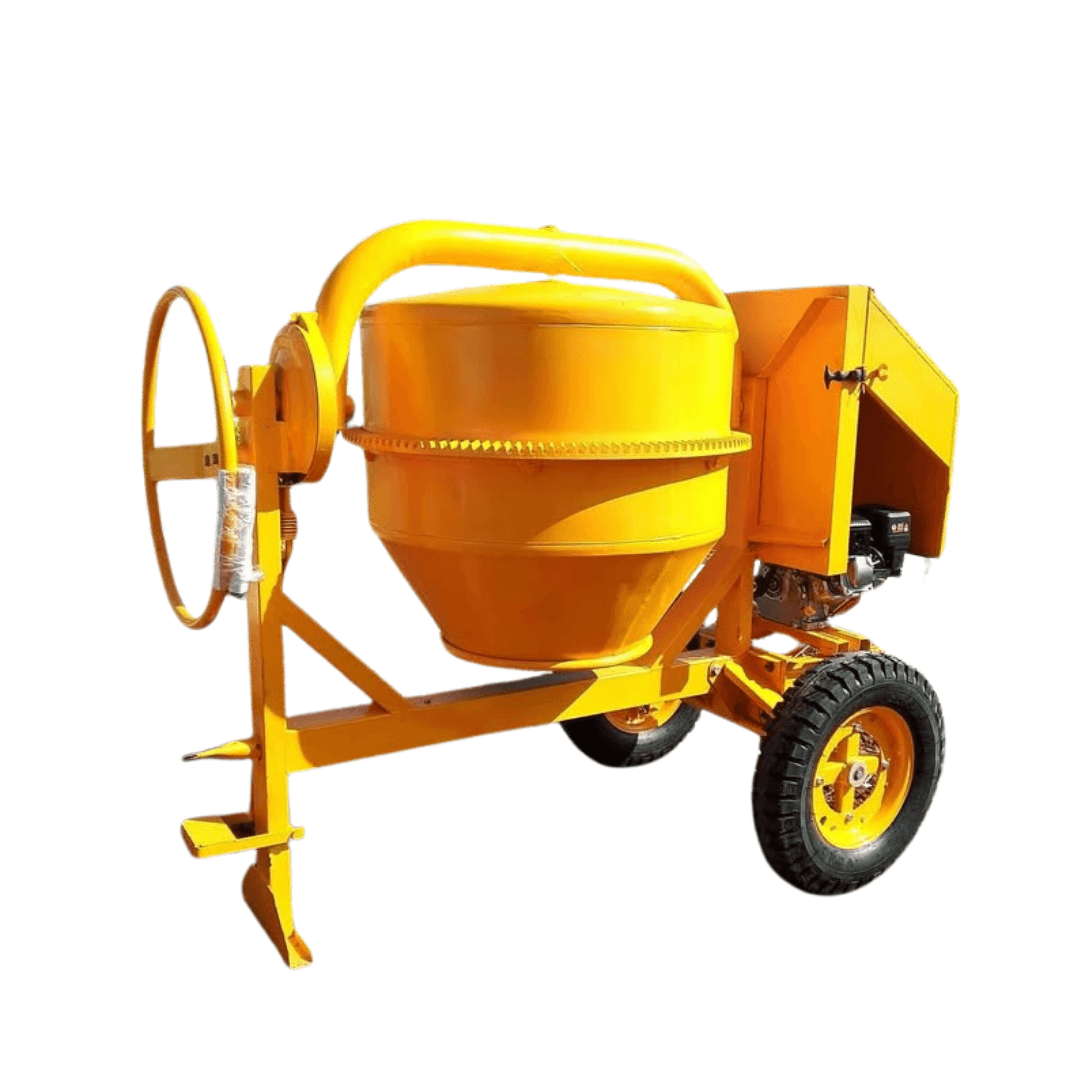
Choosing the right concrete mixer depends on three main factors: project scale, terrain, and engine availability in your market.
1. Drum Capacity
The most visible spec is drum capacity. As a general rule:
- 250L — residential and small repairs
- 350L — medium construction and road works
- 450–500L — large projects, high daily output demand
Keep in mind the actual mixing volume is roughly 60–65% of the drum capacity. A 350L drum yields about 200–220L of mixed concrete per batch.
2. Engine Type
The three engine types each suit different use cases:
| Engine | Best for |
|---|---|
| Electric (2.2–5.5 kW, 220V) | Permanent sites with grid power |
| Gasoline (GP160/GP200, 5.5–6.5 Hp) | Remote or semi-permanent sites |
| Diesel (CAOFONG, 8–12 Hp) | Heavy-duty, no power access |
Electric engines are cheapest to run but require 220V supply. Gasoline offers the best balance of portability and power. Diesel is for demanding environments with no electricity.
3. Wheel Configuration
- 2 wheels — lighter, easier to maneuver in tight spaces
- 4 wheels — more stable on uneven terrain, preferred for sloped sites
For pneumatic vs. solid tires: pneumatic tires (5.00-12) absorb shock better over rough ground. Solid tires (4.00-8) require zero maintenance and never go flat — popular in markets with limited tire repair access.
4. Drum Thickness
At Phu Long, we use 2mm upper / 2.5mm lower drum for 250–350L models, and 2.5mm / 3mm for 450–500L. Thicker drums mean longer service life but add weight. For export markets with heavy use, we recommend specifying the thicker option.
Summary
Match the model to your market's power infrastructure and typical project size. Most of our export customers in Southeast Asia and Africa choose the 350L gasoline variant — it's the most versatile. For OEM orders with custom color and logo, any model can be configured to your specification.